


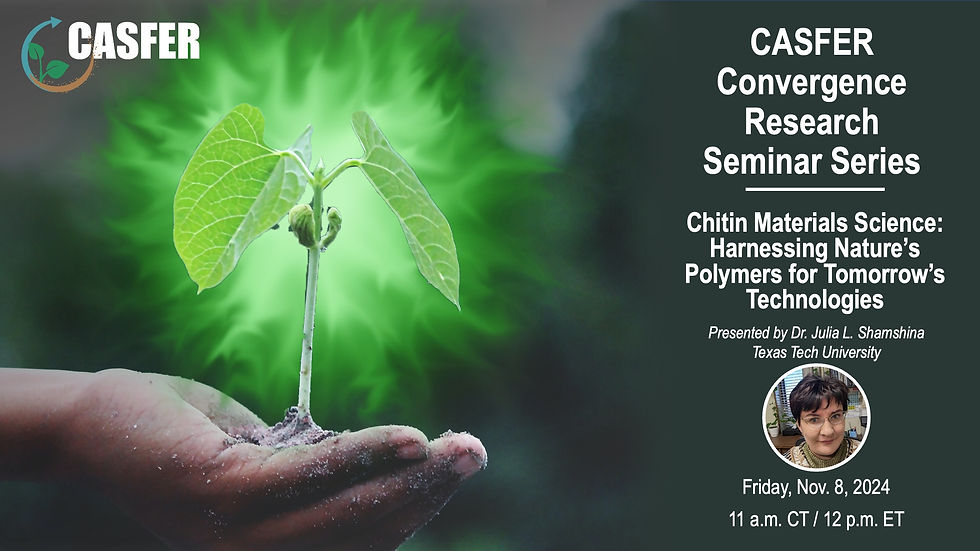
CCR Seminar: Chitin Materials Science: Harnessing Nature’s Polymers for Tomorrow’s Technologies
Fri, Nov 08
|Zoom Webinar
Dr. Julia L. Shamshina (Texas Tech University) in the CASFER Convergence Research Seminar Series
Time & Location
Nov 08, 2024, 11:00 AM – 12:00 PM
Zoom Webinar
About the event
Abstract:
Biopolymers like cellulose and chitin are highly promising raw materials for bioplastics production. Contrary to common perception, bioinspired manufacturing and sustainable materials aren’t a mere substitute for synthetic polymers; rather, they represent an enabling technology that establishes a new paradigm in manufacturing, allowing for innovations beyond the capabilities of traditional synthetic polymers. Unlike conventional plastics, which are largely processed through methods such as injection, extrusion, blow, or rotational molding, these bio-renewable polymers cannot be melt-processed. As a result, they are not directly compatible with standard melt-processing technologies. Instead, they require solubilization to create biopolymeric materials. Over the past two decades, solution processing of biopolymers in ionic liquids (ILs) has emerged as a highly promising strategy for effective biopolymer handling. This approach has expanded access to functional products across a range of values: from low-value applications like packaging to medium-value uses in catalysts, and high-value applications in drug delivery, tissue…